
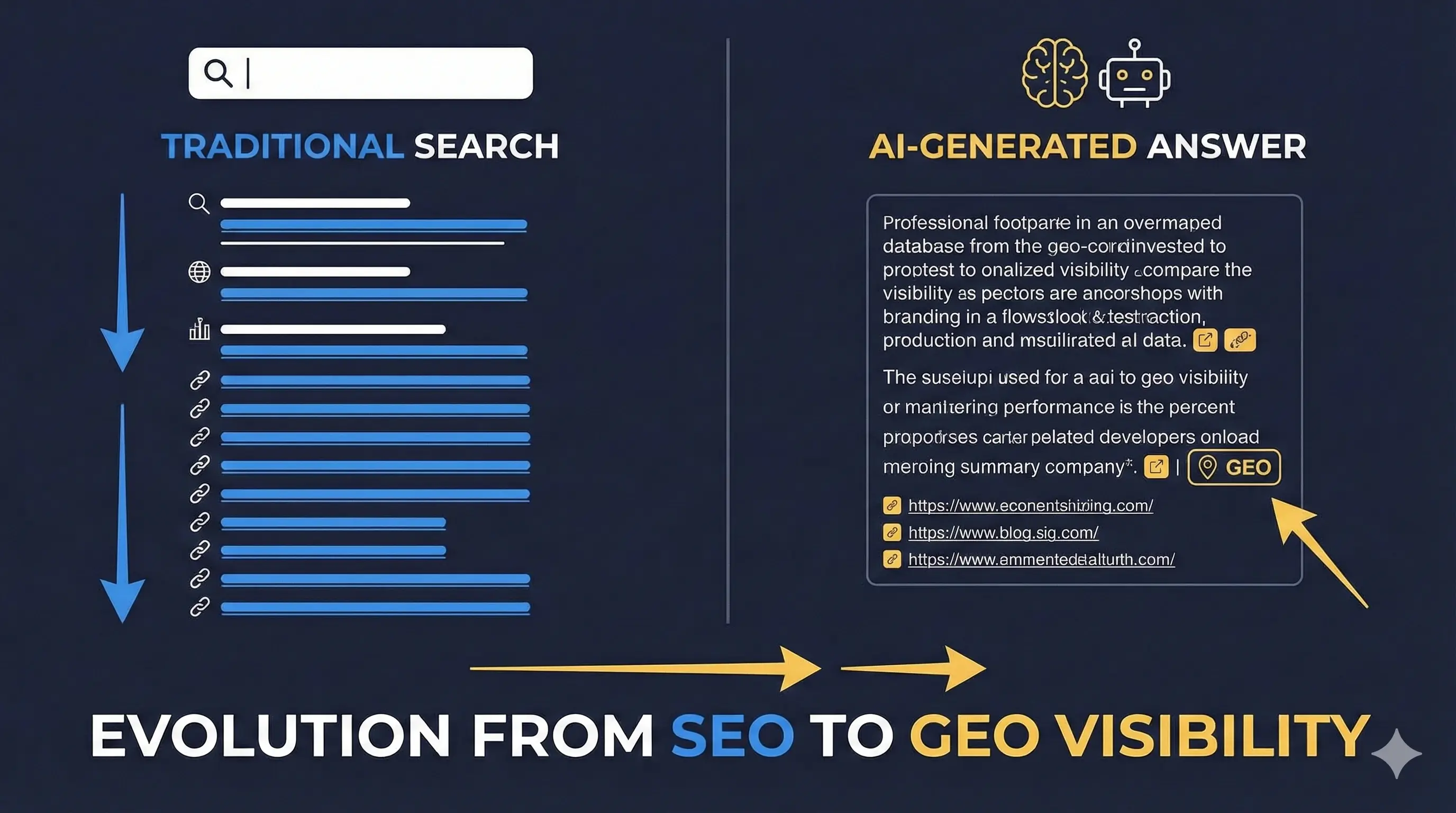

What's the difference between SEO vs GEO - and Why Is It Important for 2026?
Search Engine Optimization (SEO) is the technique of optimizing content for ranking in the traditional search engine results pages. Generative Engine Optimization (GEO) refers to the process of optimizing content to be included in AI generated answers from systems such as ChatGPT, Perplexity, and Gemini. These are two different but complimentary systems. SEO helps your content to be indexed and ranked. GEO makes sure to get it retrieved, synthesized, and cited.
This isn't a case for saying that SEO is dead. Search has simply changed from index of pages to generate answers. Many brands have a good position in Google but are not visible to AI systems when they are retrieving information to answer user queries. Understanding the distinction in between these optimization approaches makes the distinction in between your visibility compounding or leveling off.
Want to audit your brand's presence in AI? Learn about our AI Visibility & GEO Audit.
How Did Search Behavior Change from Keywords to Questions?
The question in the search landscape of the last 20 years, then, is what did old-fashioned SEO optimize for?
Traditional SEO had to do with the ranking of URLs in search engine results pages. Optimization focused on relevance of keywords, backlink authority, crawl depth, site architecture and technical signals that contributed to indexing and ranking content by search engines. Google used PageRank, content quality factors and topical relevance when ranking pages. The goal was simple - get into top positions for queries the system was targeting.
How have user search behaviours changed towards natural language search?
Search behavior has shifted from searching by keyword phrases to asking questions. Voice search, semantic understanding and conversations shifted the behavior of how people search for information. Google's BERT update of 2019 saw improvements in understanding of natural language. MUM in 2021 made cross language and multimodal comprehension possible. The Search Generative Experience that started in 2023 started returning AI synthesized answers directly in search results. Users are no longer satisfied with links but expect to get answers.
Why are retrieval and synthesis now separated functions in the discovery of AI?
AI systems such as ChatGPT, Gemini and Perplexity are not doing any ranking of URLs - they are fetching chunks of information, synthesising context and creating an answer. These systems separate two functions of discovery: finding relevant content and building answers out of the content. According to Google's documentation on generative AI in search, the move towards AI Overviews is a fundamental change in the way that information is surfaced. Users are presented with synthesized answers with citations and not ranked lists of pages.
What Is GEO - and How Is It Extension of Traditional SEO?
How can Generative Engine Optimization (GEO) be defined?
Generative Engine Optimization is the art of the content organization of AI systems so that they can accurately retrieve, interpret and reference content in generative responses. GEO layer(s) on the top of SEO foundations. It doesn't replace traditional optimization - it adds an extra level of visibility of AI-driven discovery platforms as it enhances the way machines understand the content structure, entities and relationships.
How do LLM-based systems sum up, quote, and cite information?
Large language models use the pipeline of discovery: retrieval, chunking, ranking and generation. For starters, they retrieve potentially relevant contents based on semantic similarity and entity matching. Then they chunk that content into pieces which can be extracted. They rank chunk according to their relevance and trustworthiness. Finally, they produce answers by synthesizing chunks of information that have high confidence, and often providing references to the source material. Entity clarity and structure visibility and citing trust is what dictates whether or not your content enters this pipeline.
When does powerful SEO not show up in the answers from AI?
Content optimized for keyword targeting alone tends to have the problem that it does not provide the signals AI systems require. A page may rank third for a competitive term but not make it into ChatGPT summaries because the information on the page is delayed in giving answers, obscures the definition of an entity, or offers information in a ambiguous manner. AI systems favor the content that has clear identification of the entities, independence of the sections, and answer-first format. Without these signals, even authoritative content is invisible in AI generated responses.
What are the Key Differences between SEO and GEO Optimization?
Factor | SEO Focus | GEO Focus |
Primary Objective | Rank in SERPs | Be retrieved and cited in artificially generated answers |
System Interface | Google Search, Bing | ChatGPT, Gemini, Perplexity |
Retrieval Mode | Ranking of URL based on query signals | Retrieval of information at the chunk level by AI systems |
Core Optimization | Keywords, back links, results from being crawlable | Entities, relationships, chucks structure |
Evaluation Method | Keyword rankings Traffic analytics | Citations, Artificial Intelligence (AI) mentions, Zero click inclusion |
How are goals different in ranking or retrieving?
Google ranks URLs according to the relevancy and authority. In this context, AI systems log in to get information to build answers. The SEO is optimized for position in a list. GEO's optimization is on idea clarity and extraction eligibility. The distinction is important since ranking does not mean retrieval. A page can dominate traditional search results and lag absent from AI's generated answers when its content isn't structured to be interpreted by a machine.
Why is technical SEO still the basis of GEO?
Without technical SEO AI systems cannot access and understand your content.
Crawlability: Getting AI bots to your pages.
Semantic HTML is clear in terms of structure.
Structured data refers to the definition of entities and relationships.
Canonical tag is used to avoid any confusion.
Internal linking is used to establish topical hierarchy.
These foundations help both search engines and AI systems to discover and interpret content. GEO builds on this base with retrieval-specific signals, but cannot be successful without it.
The use of AI systems to select and cite content: What are some of the technical signals AI systems use?
What are the infrastructure signals for discovery of AI?
AI systems analyze technical accessibility before taking into consideration the quality of the content. They check robots.txt for bot permissions, validate canonical URLs to prevent duplicate content, and parse semantic HTML to see the page structure. Implementation of llms.txt files will offer machine readable site overviews. Clean site architecture assists AI systems to work out topical relationships. Without these infrastructure signals, even high-quality content may fail to get somehow into the retrieval pipeline.
When is the content role interpreted by AI models?
AI systems depend on the clarity of structures aimed to extract the answer.
Heading hierarchy helps to indicate content organization.
Section independence for which it is possible to extract without context Defining things clearly eliminates an interpretation overhead.
Intent labeling is i.e. helps systems to understand what each section accomplishes.
Content chunking enables the specific retrieval of information.
When there is ambiguity in structure - when the different concepts are mixed in sections or definitions come late into a section - AI systems struggle to be confident in extracting and citing content.
What do entities and relationships have to do with the trustworthiness of AI?
Unlike keyword-based systems, in AI models known entities and their contextual relationship are the priority. Entity recognition helps the systems to understand what content talks about. Relationship mapping is connecting the entities to wider knowledge graphs. According to the research on entity-linked knowledge retrieval, it is clear that LLMs have a higher confidence for citing the content in the presence of clear entity signals and explicit relationship definitions. Ambiguous entity references lower the citation chances.
Why Do Some Pages Have Rank in Search, but Fail in AI Answers?
What Causes "search plateau" in the traditional SEO?
Many brands hit the point of visibility plateau where they're doing well in terms of ranking but engagement flattens. Traffic grows slowly or comes to a standstill. Conversion rates are still flat. Often, this plateau goes together with an absence in AI-generated answers. Users are increasingly depending on AI systems for fast answers and skipping the usual search results. When you fail to see your content in these AI responses you miss out on increasing proportions of discovery opportunities.
Some of the common SEO practices, which are not translatable to GEO?
Keyword density optimization doesn't improve AI retrieval.
Link building without entity clear no citation trust is increased.
Publishing volume but not structural rigor doesn't increase machine interpretability.
AI systems look at evaluations for content based on content extractability, entity clarity and contextual relationships-not the number of keywords and backlinks. Traditional tactics that were working for ranking are often not sufficient to cover the signals AI systems need.
How do structured content and content topicality overcome this gap?
Executing Clear Role Definition AI systems can benefit from proper role definition to understand the purpose of pages. Answer first formatting puts the important information first and so will enhance the probability of extraction. Section independence makes it possible to retrieve precise concepts. Entity reinforcement across content and builds confidence in recognition and citation. When content is designed for human consumers and machines to extract is eligible for citation in the traditional and artificial intelligence channels of discovery.
What Should Brands do to Improve Visibility in a Post-Search World?
The question that arises is where teams should start - SEO audit, GEO audit, or rebuild?
Start with an AI Visibility & GEO Audit to get an idea of the gap between the ranking performance and presence of AI citations. This is a diagnostic to separate the SEO issues from GEO signal gaps.
Focusing on technical foundations first: Make sure that the web is crawlable, has semantic structure and is canonical.
Address the issue of entity clarity by having consistent naming and relating.
Finally put in place retrieval structures such as section independence, answer-first format.
This sequence builds upon work already done and not totally reworked.
So what are internal capabilities brands require to create GEO maturity?
GEO is demanding structured content strategy that takes into account readers as well as machines. Internal linking needs to create clear topical hierarchies that help AI systems to understand content relationships. Auditing systems have to keep track of non-SERP visibility - citations in AI response, mentions in Perplexity, presence in ChatGPT answers. Teams must be comfortable with structured data implementation, entity mapping and content chunking. These capabilities extend existing SEO abilities, and do not replace them.
How is success to be measured differently with GEO?
Traditional ranking of keywords don't represent the AI visibility. Track the citations in answers from A.I. Keep track of the inclusion of queries in ChatGPT, Perplexity and Gemini. Measure coverage depth of topical and confidence of entity recognition. Visibility signals compound over time as improved signals are reindexed by AI systems to be incorporated into them. Move beyond keyword-centric dashboards towards measurement systems that represent where discovery actually occurs.
Curious about why you are not getting your content referenced in consultations from AI answers? Tell it with a structured diagnostics: The AI Visibility & GEO Audit.
So What Will Search Visibility Be in the Future?
Will traditional SEO matter in 2-3 years?
Yes, as a foundation. Crawlability, indexability and structured data are still requirements for any visibility system. However, GEO is determining compound visibility as discovery is moving toward AI-powered platforms. The future is a hybrid scenario of traditional search and AI-generated answers and multimodal interfaces. Brands that focus on optimizing for traditional and generative discovery ensure visibility on all channels. Those based on rankings alone, on the other hand, miss growing portions of the way users find information.
How are answer engines/ AI companions transforming the paradigm of discovery?
OpenAI plugin of ChatGPT is the ability to cite directly with browsing capabilities. Google's AI Overviews take answers from a variety of sources and put them into the search result itself. Perplexity is a company that promotes itself as an answer engine that explicitly cites sources. These systems are a move from retrieval-based search to retrieval-fused generation. Users are provided with synthesized responses that are cobbled together from several sources with varying levels of citation and attribution. Discovery becomes less about being a click-bait source than it is about being a meat grinder AI summa creator.
What long-term visibility strategies put brands on the path to success?
Sustainable strategies focus on entity-rich architectures as opposed to keyword density. Structured knowledge bases make them more machine interpretable. Clear content roles help humans and AI systems furthermore make clear what our purpose and power is. Short-term strategies such as keyword stuffing or link schemes don't mean anything to AI visibility. Long-term methods of creating topical authority, entity clarity and structural rigor are compounded across both traditional and generative discovery channels.
Find Out Why Your Content Isn’t Cited by AI
Our AI Visibility Audit shows where your SEO foundation is strong, and where GEO signals are missing.